Life Lessons From HIIT: How Intense Cardio Can Transform Your Body and Mind


High-intensity interval training (HIIT) cardio has become my new jam. For the better part of four decades, I hated cardio like poison. If you’d told me five years ago that I’d be pushing fifty and love doing cardio, I would’ve laughed in your face.
Now, I’m still not a fan of steady-state cardio. I see it as just burning calories for the sake of burning calories, with the increased risk of catabolism compromising muscle mass when you force it into a deep caloric deficit.
Yet I recognize that cardiovascular fitness is critical for maintaining a healthy lifestyle. Especially as you age, and training for longevity transitions from effort-based to identity-based motivation.
What Is HIIT Cardio Training?
High-Intensity Interval Training (HIIT) involves alternating bursts of high effort with short recovery periods. Intervals can last 20 to 40 seconds at 85–95% max heart rate, followed by 60 to 90 seconds of recovery. This differs from the often-monotonous grind of steady-state cardio, where you’re essentially jogging for 30 to 60 minutes at the same pace.

With HIIT, you deliberately spike your heart rate, allow partial recovery, then repeat the cycle. It doesn’t have to be running; the same principles can be applied to cycling, rowing, bodyweight circuits, or high-intensity, low-weight resistance exercises. Running just happens to be an easy way to apply metrics for intensity and duration.
The defining characteristic is the intensity and contrast between effort and recovery. HIIT trains your cardiovascular system to adapt to stress, recover quickly, and handle repeated surges of demand.
This more closely mirrors much of how your body is asked to perform in the real world. You run to catch the bus. You sprint up a flight of stairs to make a meeting you’re late for. Your heart races just before asking that special someone out for coffee.
The Benefits of HIIT Cardio
The biggest advantage of HIIT cardio is efficiency. You can achieve a serious cardiovascular and metabolically intense workout in a fraction of the time required for traditional steady-state cardio.
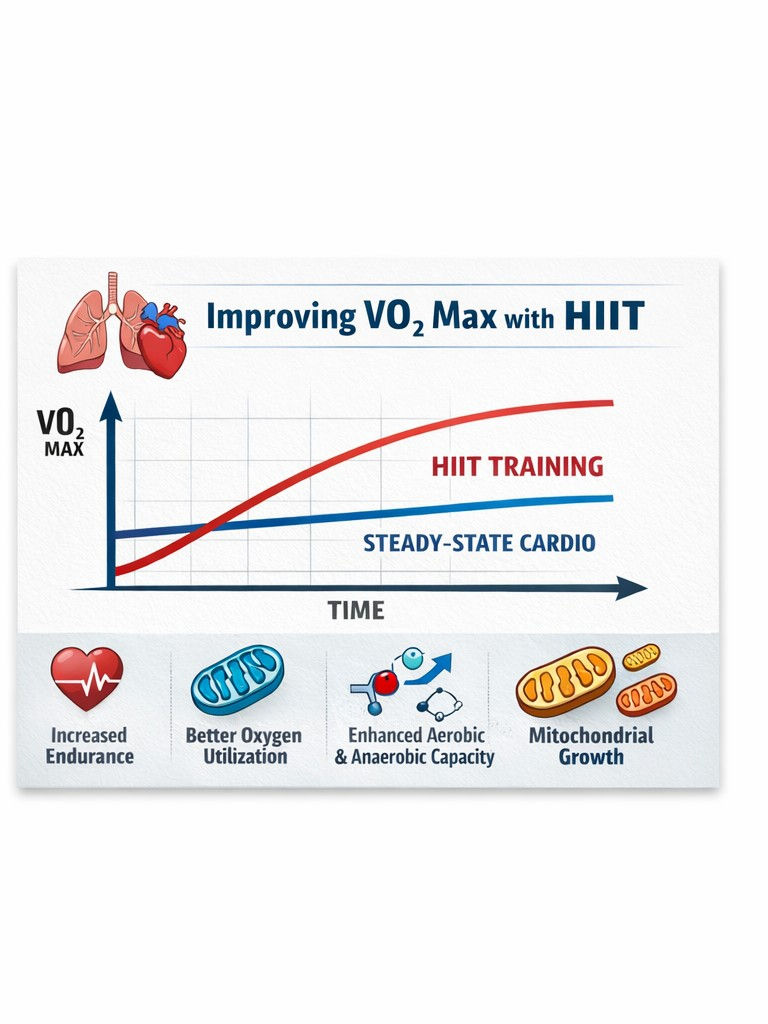
The intense intervals stimulate both your aerobic and anaerobic systems, improving endurance, work capacity, and VO₂ max. HIIT also produces a pronounced “afterburn” effect, meaning your body continues burning calories after the workout as it recovers.
There’s also a psychological advantage in that HIIT’s shorter, dynamic bursts of effort tend to feel more engaging than the repetitive grind of steady-state cardio. Pushing yourself to sprint a little harder or a little farther than last time adds challenge and novelty. This keeps you engaged in each leg of the workout compared to jogging on a treadmill for thirty minutes, hoping for a slightly better time.
HIIT Helps Preserve Muscle Mass
As someone pushing 50 whose core workout program focuses on building and maintaining muscle mass, I appreciate HIIT’s reduced risk of muscle catabolism. Long-duration, moderate-intensity cardio, especially when paired with a caloric deficit, often encourages your body to break down muscle for energy.

This becomes a major concern as we age, as “Muscle is the currency of longevity.” Losing muscle affects daily function, raises the risk of dangerous falls, and can increase susceptibility to metabolic conditions like type 2 diabetes and insulin resistance.
HIIT emphasizes intensity over duration, giving you the metabolic conditioning benefits without the prolonged catabolic stress that can erode hard-earned muscle.
I’m not saying steady-state cardio is bad. It certainly has its place. Yet if your goal is fat loss, performance, and preserving muscle, HIIT is often the more strategic form of cardio.
Why HIIT Cardio Is So Powerful
HIIT training has more benefits than simply getting in a quick, effective cardio session. It can also help boost natural testosterone levels, increase human growth hormone production and improve your mitochondrial health.
Boosts Natural Testosterone Levels
Short, intense bursts of effort stimulate acute hormonal responses, including increases in testosterone and growth hormone. Heavy effort signals to your endocrine system to increase production of testosterone and other growth hormones.
Maximizes VO₂ Max Cardiovascular Capacity
HIIT challenges both your aerobic and anaerobic systems at the same time. This forces your heart, lungs, and mitochondria to become more efficient at delivering and using oxygen — dramatically improving overall endurance.
Improves Insulin Sensitivity
HIIT rapidly depletes muscle glycogen, which enhances your muscles’ ability to absorb glucose afterward. This improves blood sugar regulation and reduces the risk of diabetes.
Accelerates Fat Loss
The way HIIT increases post-exercise oxygen consumption, AKA the “afterburn effect,” helps your body continue to burn calories even after the workout ends.
Builds Mitochondrial Density
Mitochondria are the “energy factories” of your cells. HIIT stimulates mitochondrial biogenesis, improving your body’s ability to generate ATP for more energy and better stamina.
Strengthens the Heart Muscle
Repeated high-output intervals train the heart to pump more blood per beat. Over time, this makes your cardiovascular system stronger and more resilient.
HIIT Mindset Training
I do my HIIT cardio early in my day, and I’ve found it to be a great tool for getting my mind right. Especially since I run alone, running in the winter forest behind my house like Rocky Balboa training in Russia.
My HIIT workouts aren’t in a gym or a class with other people. It’s just me, a frozen trail, my thoughts, and my golden retriever. There’s no one else watching. No instructor is holding me accountable, and no other classmates to compare myself with.
The First Leg
After a stretch and warm-up, I start the first leg, where I am never at my best. The right knee groans, the stiffness in the arch of my foot tells me to just stop. My mind starts whispering, "No one is watching; you don’t have to push this hard."
There’s an element of internal mental resistance, just like you get in other areas of your life when uncomfortable change is pushed on you. That meeting you don’t want to go to, that you could slink out of. The salad you know you should order for lunch, when you want to give in to that greasy cheeseburger.
Pushing myself through that uncomfortable first leg is just as much about willpower as it is about reminding my brain that there’s a benefit to going through something uncomfortable.
The Limited Pause
I have a rule when it comes to the short rest after each leg of a HIIT cardio session. I’m allowed to take 5 deep breaths with my hands on my hips. Five breaths, nothing more, and then I’m in motion again. Huffing and puffing if I need to, but I’m only allowed to stop for five breaths.
This has nothing to do with breathing. It’s about forcing myself back into a sense of agency.
Pausing and procrastination live in the same circuitry in the brain. So, by forcing myself to get moving, even though a part of me wants to stay put, I’m reinforcing the conditioning in my brain to always keep moving forward on the things that need to get done.
The Second Leg
The second leg of the run is usually easier. The sore spots have blood flow, and my mind is ready to face the challenge ahead. On my preferred route, the second leg ends on a slight uphill stretch. There are a bunch of little trees that I can use as guide markers.
Then I do my best to push that sprint phase a little farther than I did the time before. Maybe it’s just a step or two. Maybe I can push through the burning pain in my legs and the coppery taste in the back of my throat to that next sapling.
Putting this last little push right at the end, I’m doing more than just getting 1% more out of the workout. It’s also about creating a sense of accomplishment. I pushed myself to go a little farther than I’ve ever gone before.
My girlfriend isn’t cheering for me, and the instructor isn’t yelling in my ear. It’s me choosing to push myself, one little bit more in a way that empowers my personal sense of agency.
Once again, there are the same pause requirements. Five breaths, nothing more, and then I’m power walking again.
The Third Leg
The third leg of an HIIT cardio session for me is the most empowering. My muscles are now hot, my lungs are ready, and all the little stiff spots that remind me I’m pushing 50 are on board with what’s happening. Now this is where I really push myself.
This leg isn’t a sprint. It’s 75% of my maximum capacity for as long as I can go. This is a test of will. It’s me against me, which, if you’re honest with yourself, is really the root of most of the challenges in your life.
The third leg of an HIIT cardio session like this is always my most productive. It also serves as a reminder of how I need to set myself up in my day. I want to warm myself up in my workday challenges, so that I’m completely ready for the big thing. Whatever that is.
If I have to give a big presentation, I’ve already warmed myself up in advance by chatting up the lady behind me at the coffee shop or doing a practice presentation with some friends. So that I’m not walking into the big moment cold. I’m coming in hot, ready, and feeling prepared.
The Last Leg
Depending on how long I design a HIIT session for last leg is always the hardest. This is true of the real challenges in life as well. That road trip you take with the family, it’s the last leg driving home that feels like it takes forever. The ten-hour day you put in to make sure you have everything buttoned up for that proposal tomorrow morning always drags at the end.
Doubling down to really finish strong on that last leg of a HIIT cardio session is also wiring my brain to push through on all the challenges ahead that are going to leave me tired. Because it’s that ability to perform in the face of exhaustion and doubt that sets apart the people who succeed in the end.
HIIT Cardio: A Workout and Psychological Tool
The way I see it, HIIT cardio is more than just a workout; it can also be a tool to help maximize your mindset. Using it as a way to challenge yourself teaches you to embrace discomfort, push past resistance, and recover quickly. All while preserving your strength and resilience.
Each leg of a HIIT workout session is a small test of willpower, a chance to incrementally improve. The principles of intensity, recovery, and mental focus translate directly beyond the trail or treadmill. As you learn to embrace them, you’ll also see how they carry over into your career, relationships, and how you shape your personal goals.


Comments