How to Use SEO Content Strategy for Affiliate Marketing
- Eric Beuning
- Feb 11
- 5 min read


Affiliate marketing is an increasingly popular way for content creators to build passive income. It seems as simple as publishing content, placing links, and watching the commissions roll in.
Unfortunately, the reality is that sustainable affiliate revenue is rarely the result of simply slapping together articles with cleverly embedded links. Long-term success usually requires strategically structured SEO content strategy that’s designed to build traffic-generating assets over time.
Without a strategy, even well-written content struggles to rank, attract qualified visitors, or convert readers into buyers. However, with the right strategies, affiliate websites can evolve in a way that leads to compounding traffic systems capable of producing consistent revenue.
Understanding how SEO content strategy supports affiliate marketing is less about tactical tricks and more about connecting with the search intent.
Affiliate Marketing Needs to Develop Authority
One of the most common misconceptions in affiliate marketing is the idea that success is driven by individual posts and articles. Inexperienced affiliate marketers often publish scattered reviews, comparisons, and “best-of” lists without a cohesive framework.

Unfortunately, popular search engines like Google don’t reward randomness. Instead, they evaluate topical authority, structural coherence, and look for content that resonates with search intent. A site with disconnected articles resembles a collection of experiments rather than a high-authority source.
Why Search Intent Drives Affiliate Revenue
The core of any effective affiliate marketing SEO strategy starts with identifying search intent. This is the underlying reason behind a query that a user might enter. Such as “What are the best hydration backpacks for desert hiking.”
Understanding this distinction is critical for affiliate marketing because traffic alone does not guarantee conversions.
Common Search Query Categories
Search queries can often be categorized as being informational, commercial, or transactional. Affiliate revenue is typically tied more to commercial and transactional intent. Informational content plays a supporting role by capturing traffic earlier in the decision cycle.
Informational Intent
Users seeking knowledge, answers, or explanations.
Example: “What is whey protein?”
These searches are driven by curiosity or problem-solving rather than immediate buying behavior. Content targeting informational intent builds trust, authority, and organic traffic, often serving as the entry point into your affiliate funnel.
Commercial Intent
Users researching products or evaluating options.
Example: “Best whey protein for muscle gain”
At this stage, users are comparing features, benefits, and alternatives. Well-structured comparison articles, reviews, and “best of” lists perform strongly here, as readers are actively weighing purchase decisions.
Transactional Intent
Users ready to purchase.
Example: “Buy Optimum Nutrition whey protein”
These searches signal high purchase readiness and typically convert at the highest rates. Content should prioritize clarity, strong calls-to-action, pricing visibility, and frictionless paths to the affiliate link.
Many affiliate sites struggle because they prioritize keywords based on volume rather than search intent and readability. High traffic with low purchase motivation produces minimal revenue. Moderate traffic with strong buyer intent often outperforms large audiences with weak conversion potential.
Keyword Research Beyond Basic Metrics
Effective keyword research for affiliate marketing purposes extends beyond basic search volume and difficulty scores.
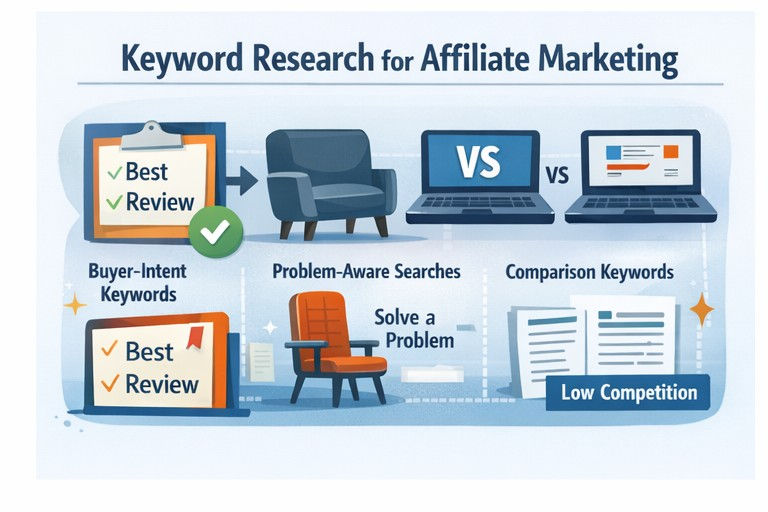
High-performing affiliate strategies focus on:
Buyer-Intent Keywords
Queries indicating purchasing consideration.
Examples: best, review, vs, comparison, alternatives
These keywords signal that the user is already moving beyond basic research and actively evaluating solutions. Content targeting buyer-intent terms should focus on decision-making factors such as features, benefits, drawbacks, pricing, and real-world use cases. This is where affiliate content typically performs at its strongest.
Problem-Aware Searches
Users attempting to solve a specific issue.
Example: “Best chair for lower back pain”
These searches originate from a clear pain point or need, making them highly valuable for conversion-focused content. Articles that address the problem directly often generate both strong engagement and trust. The key is to educate first and sell second.
Comparison Searches
Users evaluating competing options.
Example: “Ahrefs vs SEMrush”
Comparison queries reflect users who are close to making a decision but need clarity between alternatives. Well-structured comparison content performs well by objectively outlining strengths, weaknesses, ideal use cases, and differences. Readers at this stage are often highly receptive to recommendations.
Long-Tail Keyword Opportunities
Long-tail keywords typically face less competition and attract users with very precise intent. While traffic numbers may be smaller, the visitors are often more qualified and more likely to convert. A strong affiliate strategy often relies on accumulating many long-tail wins rather than chasing a few high-volume terms.
Affiliate marketers frequently overemphasize high-volume keywords while overlooking intent-rich, lower-competition phrases. A keyword with modest traffic but strong commercial intent often generates superior ROI.
How to Build Topical Authority
Popular search engines like Google reward topical authority in ranking affiliate marketing content. This is the perceived expertise and comprehensiveness of a site within a subject area. Content architecture varies in importance by type.
Pillar Content
Comprehensive resources covering core topics.
Example: “Complete Guide to Home Espresso Machines”
Pillar pages serve as the foundation of an SEO-driven affiliate strategy. These long-form resources target broad, high-value keywords while providing structured overviews of an entire subject. They create a central hub that distributes authority to related supporting content through internal linking.
Supporting Articles
Focused pieces addressing subtopics.
Examples: reviews, comparisons, and troubleshooting guides.
Supporting articles expand on specific angles that the pillar page cannot fully cover. These pieces often target long-tail and buyer-intent keywords, allowing the site to capture more precise searches. They also reinforce topical relevance by linking back to the pillar content.
Topic Clusters
Groups of interrelated content connected through internal linking.
Topic clusters organize content into logical ecosystems rather than standalone pages. This structure helps search engines understand subject relationships and improves crawlability. From a user perspective, clusters create smoother navigation and longer session durations.
Architecture & Authority Statement
This architecture signals expertise. A site demonstrating depth across related subjects appears more authoritative than one publishing sporadic articles targeting disconnected keywords. Search engines reward this perceived authority, while readers benefit from a more cohesive and trustworthy experience.
Types of Affiliate Content That Perform Best
A site relying solely on buyer content often struggles with authority. A site relying solely on informational content struggles with monetization. Effective strategies integrate both.

High-performing affiliate websites typically balance two core content categories:
Commercial / Buyer-Focused Content
These articles capture users actively evaluating purchase decisions.
Best-of lists
Product comparisons
Individual product reviews
Alternatives and recommendation guides
Informational Traffic-Building Content
Informational content attracts broader audiences, builds trust, and creates internal linking opportunities that support commercial pages.
Educational guides
Tutorials
Problem-solving articles
Industry insights
On-Page SEO for Rankings and Readability
On-page SEO remains essential, but over-optimization can degrade content quality. Search engines increasingly evaluate behavioral signals such as engagement, dwell time, and satisfaction metrics. Content written exclusively for algorithms often underperforms content written for humans that has things like:
Clear, intent-aligned titles
Logical header structure
Semantic keyword integration
Comprehensive topic coverage
Engaging, readable formatting
Internal Linking as Behavioral Design
Internal linking is frequently misunderstood as purely technical SEO. A reader entering through an informational guide can be naturally directed toward comparison or recommendation pages. This includes strategic use of content that:
Distributes authority across pages
Guides readers through logical pathways
Connects informational and commercial content
Supports conversion journeys
E-E-A-T Signals
Google’s emphasis on Experience, Expertise, Authority, and Trust (E-E-A-T) has reshaped SEO content strategy for affiliate marketing. Thin, generic reviews increasingly struggle to rank as Google and other popular search engines look for trust signals that:
Demonstrate expertise
Transparent disclosures
Authentic analysis
Depth of coverage
Consistent topical focus
Strategic Takeaway
Successful affiliate marketers don’t just publish content with embedded links, they create search-driven ecosystems. SEO content strategy reframes affiliate marketing as asset development rather than content production.
Sustainable affiliate marketing success is rarely accidental. It’s engineered through deliberate strategy, structural discipline, and long-term thinking.



Comments